
8 Questions to Ask Before Hiring Your Tuscany Wedding Photographer
By Milos Dokmanovic, Principal Photographer at FunkyBird Photography
Updated May 2026 · 250+ weddings photographed across Italy since 2012
The short answer: Before hiring a Tuscany wedding photographer, the eight questions below will do more than any price comparison or Instagram scroll to tell you whether the person in front of you can actually deliver the photos you'll still love in 2046. The right photographer will answer all eight in detail without hesitation. The wrong one will get vague on at least three of them — and that's exactly the information you need.
After fourteen years and 250+ weddings across Tuscany, Val d'Orcia, and Umbria — and a lot of stories heard along the way from couples, planners, florists, and other photographers, the good and the bad — I've learned that the couples who love their photos have all done the same thing: they asked the right questions before booking. These are the eight that matter most.
Why these eight questions specifically
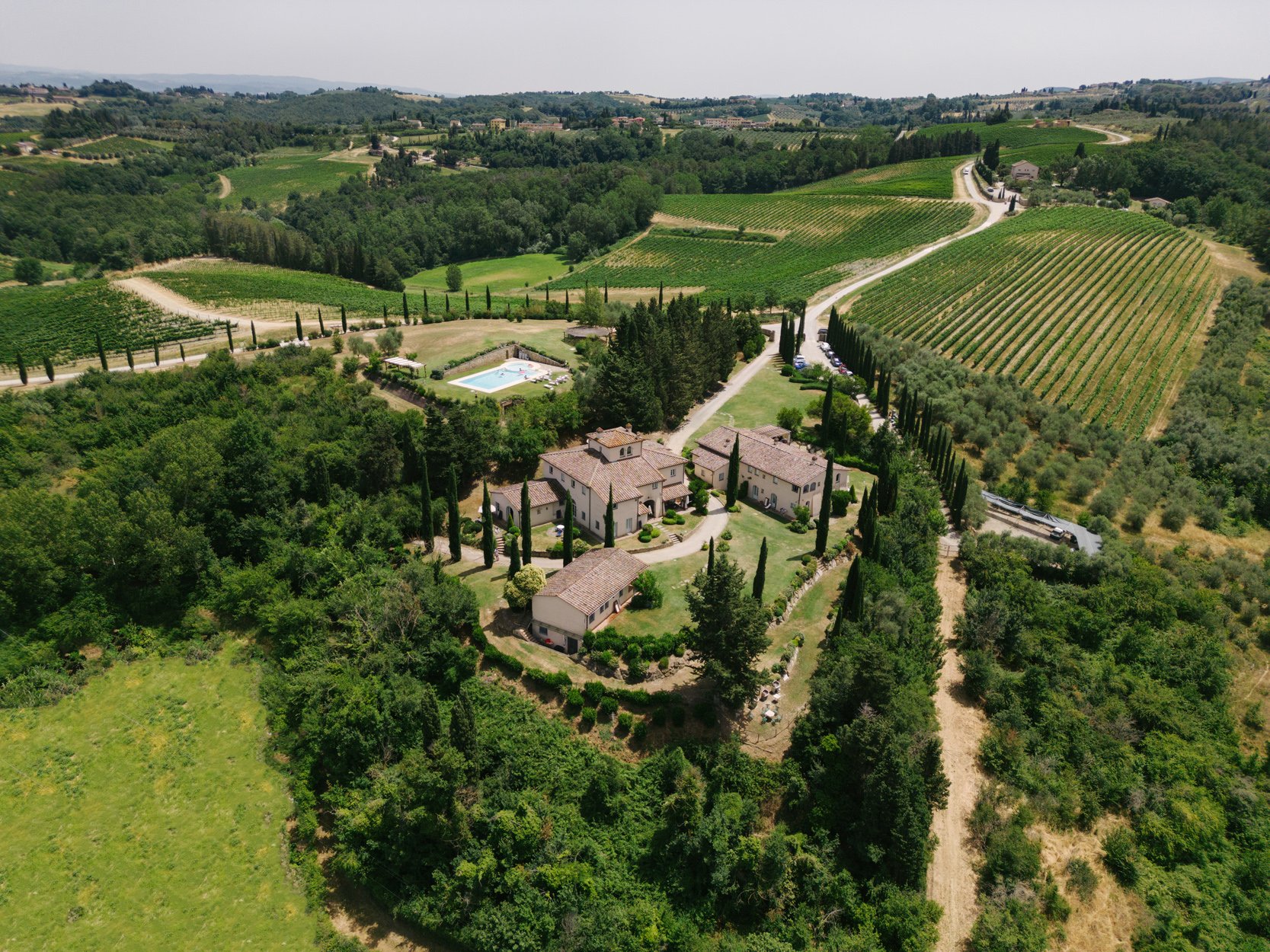
There are dozens of "questions to ask your photographer" lists online. Most repeat the same generic checklist that applies to a backyard wedding in Ohio — often written by people sitting in the offices of listing platforms and content sites who have never actually worked a wedding in their lives. A destination wedding in Tuscany has a very different risk profile. Your photographer is not down the road. The venue is rural, often 90 minutes from the nearest town. The vendor ecosystem is unfamiliar. The weather, the light, and the timeline all behave differently than at home.
The eight questions below are filtered by what actually matters when you're booking from another country, based on what couples have told me over the years went right and went wrong. Each one is designed to either confirm a competent professional or expose someone who shouldn't be photographing destination weddings yet.
The 8 questions
1. How many full weddings have you photographed in Tuscany specifically?
There's a meaningful difference between a photographer who has shot 200 weddings and a photographer who has shot 200 weddings in Tuscany. Tuscan venues, light, and the rhythm of a typical wedding day here are specific. A photographer who is excellent in London or Los Angeles but unfamiliar with the region will spend your wedding day discovering things a Tuscany regular already knows.
What you're really testing for: regional depth. Has this person built a meaningful body of work in Tuscany, or are they a generalist who passes through occasionally? Both can be talented; only one has the local fluency to handle a Tuscan wedding without surprises.
What a good answer sounds like: A specific number, a list of named venues they know well, and an honest acknowledgment of which sub-regions they shoot most often.
What a vague answer means: "I shoot all over Italy" usually means they have not built deep familiarity with any one region. For a Tuscany wedding, you want a photographer whose work in Tuscany dominates their portfolio, not someone who shoots there occasionally between weddings in very different parts of the world.
2. How do you approach timing, light, and the outdoor flow of a Tuscan wedding day?
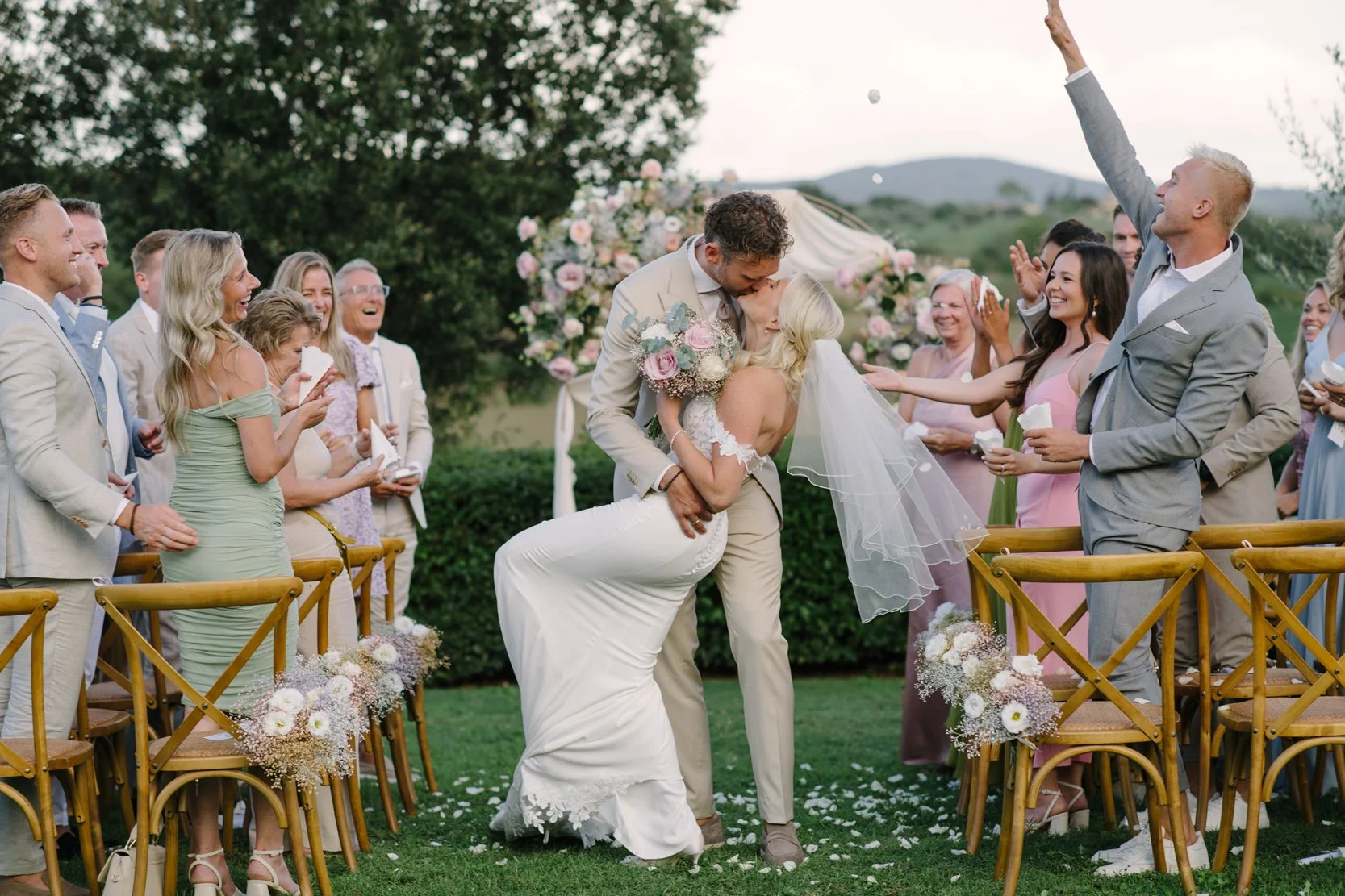
In Tuscany, almost everything happens outside: the ceremony in an olive grove or on a terrace, the aperitivo in a courtyard, the couple portraits in vineyards or cypress avenues, the dinner under string lights, the dancing on a stone patio. From late May through September, that means the sun is your photographer's most demanding collaborator — punishing at 2 PM on a stone terrace, glorious at 7:30 PM behind a hill. A photographer who has shot Tuscany regularly knows exactly when to push portraits forward or backward by twenty minutes to catch the light right, when to move guests into shade for an aperitivo so nobody is squinting, why a 5:30 PM ceremony at most Val d'Orcia venues photographs better than a 6:30 PM one in early September. They know the sun is a friend, not an enemy — but only if you know how to use it.
This is also why I tell couples that the timeline conversation is part of the photographer's job, not the planner's alone. The right photographer arrives with opinions about ceremony time, aperitivo location, and the portrait window — not because they want to dictate the day, but because they've watched 250+ Tuscan weddings unfold and know exactly where the photos go right or wrong.
What a good answer sounds like: A confident answer when you ask "what time should our ceremony start?" or "where should we do couple portraits at this venue?" They should be ready to push back gently on a timeline that won't photograph well, and to explain why.
What a vague answer means: "Whatever time you want for the ceremony works for me" usually means they haven't thought hard about light at your specific venue. For a Tuscany wedding, you want a photographer who has opinions about your timeline — and the experience to back them up.
3. How can I tell from your website and Instagram whether you've actually shot a lot of weddings — and a lot in my area?
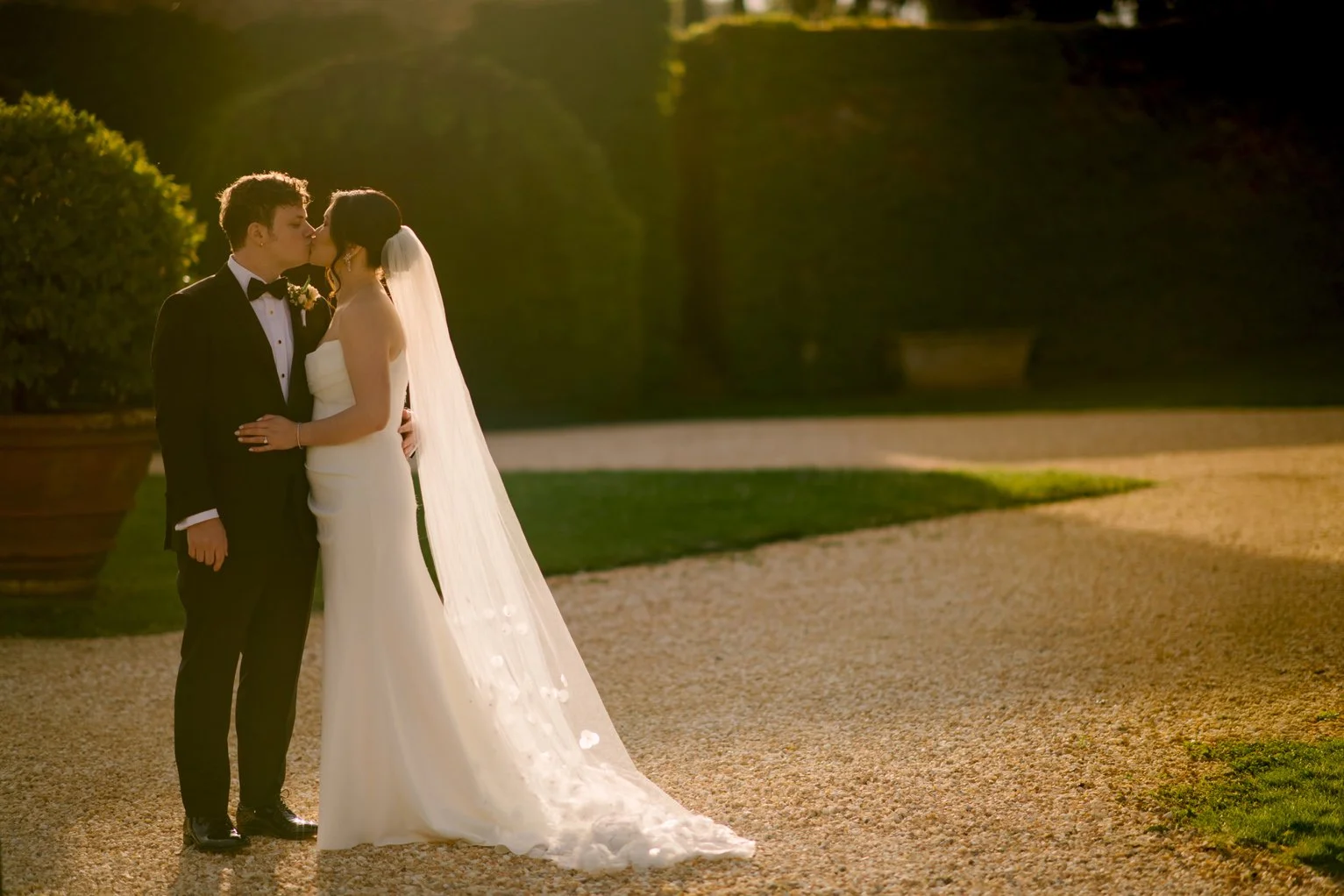
Asking for two complete wedding galleries is fair, and any professional should send them on request. But honestly, most couples don't go that far in their initial filter. Before you ever request a full gallery, you can learn most of what you need to know from a careful read of the photographer's website and Instagram. Three things to look for, and one trap to avoid.
First — depth, not just volume. A serious destination photographer should have multiple full or near-full wedding flows visible on their site. Not just a portfolio of best-of frames, but actual published wedding stories where you can see the same couple from getting-ready through the party. One or two beautifully designed "highlight" pages doesn't tell you much. Several published full weddings does.
Second — variety, not the same wedding on repeat. Open the photographer's portfolio page and Instagram together and scroll. Are you seeing the same three couples in the same two venues over and over again, just cropped differently? Or are you seeing many different brides, many different venues, many different light conditions? A photographer with hundreds of weddings of experience will have an enormous visual library to draw from. A photographer with twenty-five weddings will recycle the same handful of strong frames everywhere — same couple in the cypress avenue, same first-dance shot from the same villa, just in different aspect ratios. Once you spot it, you can't unsee it.
Third — and this is the one most couples skip — geographic concentration. Where was their work actually made? If you're getting married in Val d'Orcia and the photographer's recent feed is mostly weddings in northern Europe, the UK, or far-off destinations, with only the occasional Italian wedding sprinkled in, they're a foreign photographer who travels to Italy occasionally. That's a different product than a Tuscany-based photographer whose portfolio is dominated by work made within an hour of your venue. Both can be excellent. But for a Tuscan wedding, you want most of the recent work to look and feel like the wedding you're about to have.
One trap to avoid — don't judge a photographer by a single gallery from your venue. This one matters. Imagine the photographer has shot one wedding at your exact venue. You ask to see it. The gallery comes back and… it's fine. Not bad, not exciting. The thing is, you're not always seeing the photographer in that gallery — you're seeing that wedding. Maybe the couple didn't care much about photography and booked short coverage. Maybe the day was overcast and rushed. Maybe the styling, the flowers, and the energy of the day just weren't very photogenic. None of that is the photographer's fault, and judging them on it would be unfair. What you should judge is the whole body of their work — the portfolio, the published full weddings, the Instagram. If across all of that you love the style, the color, the mood, and the way they see people — that's the answer. One quiet gallery from a venue you happen to share doesn't override hundreds of frames you already loved.
What a good answer sounds like: "You can browse our portfolio and several published full weddings on our site, and our Instagram has a much wider archive of recent work. Of course we'll happily send you a couple of full unpublished galleries on request — but the thing that matters most is whether you like our overall style, color, and feel. That's what your wedding will look like."
What a vague answer means: A portfolio of only thirty hero shots with no way to see complete weddings. An Instagram dominated by styled shoots and detail close-ups rather than real wedding flow. A clear pattern that the photographer's recent work is geographically far from where you're marrying. None of these are necessarily fatal on their own — but each one means you should look harder before booking.
4. If I love their style on a few highlight photos, will I love it across all 900 photos of my wedding?
This is the question I most wish couples asked more often. Most couples fall in love with a photographer's work after seeing five to ten frames — usually couple portraits in flattering golden-hour light, with a particular color palette, a particular grain, a particular mood. Then they book, the wedding happens, and 900 photos arrive in that same style. That's where surprises start.
There are three things to check before you fall fully in love with a style.
First — does the style hold across the whole wedding, or just the couple shots? A heavy editorial color grade can look extraordinary on a couple in a vineyard at sunset and look strange on your 78-year-old grandmother in a group photo at midday. A dark, moody edit that flatters two people in shade can flatten a 30-person family group in bright sun. Look at the photographer's full weddings, not just their highlights, and ask yourself: do I like how everyone looks? Do the group photos still feel like real people? Do the family portraits still feel warm and recognizable? If yes — book. If you're loving the couple frames but quietly thinking the family photos look a little odd, trust that instinct.
Second — does the style change a lot from wedding to wedding, or stay consistent? Some photographers edit each wedding differently depending on mood, season, or what they think will look best on Instagram that month. That sounds creative, but in practice it means you can't predict what your wedding will look like. A consistent editing style across a photographer's last twenty weddings is a sign of a confident, mature artistic identity. Wild swings between airy and pastel one week and dark and moody the next is a sign the photographer is still figuring it out — or chasing trends.
Third — and this is the one almost no couple thinks about — does the style match the place you're getting married? Some photographers apply the same color palette to every wedding regardless of location, so a Tuscan wedding can end up looking visually similar to a wedding shot somewhere with completely different light and landscape. There's nothing wrong with that as a creative choice — and for some couples it's exactly the look they're after. But ask yourself honestly: do you want photos that feel like Tuscany, or photos that just happened to be made in Tuscany? The Tuscan light and color are some of the main reasons couples come here in the first place. If your photographer's editing style softens or shifts that light and color significantly, that's a deliberate choice, and you should make sure it's a choice you share.
What a good answer sounds like: "Look at three or four of our most recent full weddings. The style stays consistent across the day, across the people, and across the venue. The color and feel are deliberately built around how Tuscany actually looks — warm, golden, alive. If that's what you want your photos to feel like, we're a good fit."
What a vague answer means: A portfolio where the highlight reel looks one way and the full weddings look another. Big swings in editing style across recent weddings. A signature look so heavy that group photos and detail shots feel forced into the same mold. None of these mean the photographer is bad — but they mean what you're seeing in the highlights may not be what arrives in your gallery.
5. Will you personally photograph our wedding, or an associate?
This isn't a problem at most boutique studios, but it does happen — particularly with bigger agencies or studios that brand around a principal photographer's name and portfolio while actually rotating associate photographers across weddings. The work you fall in love with in the consultation may not be the work that turns up on your wedding day.
If there's any doubt, ask directly — and make sure the answer is written into your contract. The specific photographer who will shoot your wedding should be named in the agreement, not left as "a member of our team."
What a good answer sounds like: "I personally photograph every wedding I'm booked for. If you book FunkyBird Photography, I (Milos) am the photographer you'll have on the day, and you'll meet me before the wedding. It's also written clearly in the contract." Or, in a studio model: "We have three lead photographers. Let me show you the work of the specific photographer I'll assign to your date — they'll be named in the contract before you sign."
What a vague answer means: Anything that doesn't tell you exactly which human will be on-site at your wedding. If the studio reserves the right to assign whoever is available, or won't name the photographer in the contract, you're not booking a photographer — you're booking a brand.
6. What is included in the base package, and what's an add-on?
Tuscany packages vary enormously in what they include. Two photographers can quote similar prices for "full-day coverage" and mean two completely different products. A professional photographer should already have all of this clearly explained in their pricing PDF — you shouldn't have to chase the details through three rounds of emails.
What the PDF should clearly cover — without you needing to ask: hours of coverage (8, 10, 12?), number of edited images delivered, whether a second photographer is included or an add-on, engagement session, online gallery, USB or download delivery, travel and accommodation within Tuscany, VAT and tax treatment (some Italian studios add 22% VAT — the document should be explicit about whether everything is included or extra), payment schedule and cancellation terms, and any albums or prints. If something on this list isn't covered in the document you receive, ask — and notice how willingly the answer comes back.
What a good answer sounds like: A clear, well-organized PDF that walks you through every line of the package without you having to ask follow-up questions. You read it once and you understand exactly what you're paying for and what you're not.
What a vague answer means: A single price with no breakdown. A PDF that lists the headline number but is silent on hours, image count, or what's an add-on. No mention anywhere of VAT or tax treatment, or vague language like "price on request" for things that should be itemized. Surprise invoices later — for the second photographer fee, the travel zone supplement, the Saturday premium, the VAT-not-included surcharge — almost always start with a vague pricing document.
7. When will we receive our images, and is the timeline written into the contract?
Delivery times vary a lot from photographer to photographer, and that's normal — it depends on volume, season, editing workflow, and how each studio is set up. What separates a serious professional from a hopeful one is that the experienced photographer knows their own rhythm and tells you specifically. Vague answers here are usually a sign that the photographer doesn't have enough wedding history to know how long their own editing actually takes.
For context: my contract specifies delivery within two months of the wedding, but in reality I deliver most weddings within a month. On the wedding day itself I usually have a clear sense of how busy the next few weeks look, and I'll tell couples honestly — three to four weeks, four to five, sometimes longer in the busiest stretches of the season. Late September through early October is the heaviest editing window in Italy because so many weddings happen in that period, and a good photographer will be transparent about what that means for your gallery.
Whatever the photographer's rhythm is, the maximum delivery date should be clearly written into the contract — not promised verbally and not "as soon as possible."
What a good answer sounds like: A specific maximum delivery time written into the contract, paired with an honest explanation of what's typical in practice. Something like: "The contract guarantees delivery within two months. In reality most galleries arrive within a month. I'll give you a more specific estimate on the wedding day once I see what my next few weeks look like."
What a vague answer means: No delivery date in the contract. Loose verbal promises like "I'll get them to you when I can." A guaranteed delivery time so long it suggests the photographer is overbooked or under-resourced — six months is too long for a destination wedding, and one year, which a small number of photographers genuinely operate on, is unacceptable.
8. How do you handle Italian travel, accommodation, and venue logistics?
A Tuscany-based photographer should know how to handle a rural Italian wedding without you having to coordinate it. The car they drive should already be theirs. The relationships with your planner, florist, and venue manager should already exist or be easily built in Italian.
For multi-day weddings — two or three days of celebrations across the same venue — there's one practical recommendation worth keeping in mind: if the venue has a spare room, offer it to the photographer. It's better for everyone. Logistically, the photographer doesn't lose 90 minutes a day driving back and forth from a hotel, which means they're available for the moments that don't fit neatly into the timeline — a quiet aperitivo after dinner, a sunrise mist over the vineyard the next morning, a candid family moment by the pool. From the couple's side, the photographer becomes a familiar presence to the guests across the weekend. People relax around them faster, smile more naturally, and the photos start to feel like they were taken by a friend instead of a stranger with a camera. It's one of the small choices that makes a real difference to how the final gallery feels.
If the venue doesn't have spare accommodation, a serious photographer will already have a relationship with a nearby agriturismo or B&B and won't need you to organize it.
What a good answer sounds like: "Travel within Tuscany is included in the package, and I'll arrive in time to be set up well before getting-ready coverage starts. If your venue has a spare room available across a multi-day wedding, that often works better for everyone, but I'm happy either way. I already work regularly with [common planners or venues in your shortlist]."
What a vague answer means: A non-Italy-based photographer who plans to fly in the day-of, or who will charge a separate "Tuscany travel zone" fee on top of the base, or who has never worked with any of the vendors in your supplier ecosystem. None of these are necessarily disqualifying, but each adds risk and cost you should price in.
How to use these questions in practice
Don't fire all eight at a photographer in the first email. The right approach:
In the initial inquiry, ask questions 1, 5, 6, and 7. These are the qualifying questions that tell you whether the photographer is a fit before either of you invests more time.
On the discovery call or video meeting, ask questions 2, 3, 4, and 8. These are the conversation questions — you want to hear how they answer in their own words and assess whether you trust them.
If a photographer balks at any of these eight — calls them excessive, gets defensive, or pressures you to book before answering — that is itself the answer. A professional is genuinely glad to be asked. These questions tell them you're a serious couple who respects what they do.
Frequently asked questions
Are these the same questions I'd ask a US wedding photographer?
About half overlap. The Tuscany-specific questions — venue-specific portfolio reading, the outdoor-flow timing question, Italian travel logistics, the style-and-light question — are unique to a destination wedding context. A generic US-focused checklist will miss the failure modes that actually happen at a Tuscan wedding.
How many photographers should I get quotes from before booking?
Most couples I work with seriously evaluate three to five photographers. Fewer than three and you don't have enough comparison; more than seven and the process becomes paralyzing. Ask the same questions to each shortlisted candidate and compare answers side by side. The differences between professionals at the same price tier are real.
What if a photographer's answer to question 1 is honest but low — say, only 10 Tuscany weddings?
Ten weddings of legitimate Tuscany experience can still be enough if the photographer's broader wedding experience is deep, and the weddings they have shot in Tuscany match the style and venue type of yours. New-to-Tuscany doesn't always mean wrong choice. Brand-new-to-weddings does.
What's the single most important question if I only have time to ask one?
Question 4 — whether the style holds across all 900 photos of your wedding, not just the highlight frames. It's the question that protects you against the single most common gallery-day disappointment: loving the photographer's portfolio and then realizing the heavy edit that flattered two people on a vineyard hill doesn't flatter your grandmother in a group photo.
Should we ask about photo editing style and how they handle delivery?
Most of this is already covered in Question 4 (style consistency) and Question 6 (the package PDF). One small thing worth checking: do they deliver high-resolution JPEGs in a private gallery, and do they let your guests download images as well? RAW files are not industry standard to deliver, and a photographer who hands them over freely may be cutting corners on editing.
Do we need a second shooter for a Tuscany wedding?
For weddings under 80 guests at a single-location venue, usually no. For weddings over 90 guests, weddings with separate getting-ready locations, or weddings spanning multiple venues, yes. A second shooter typically adds 15–30% to the base photography fee and is almost always worth it for larger or more complex weddings.
How far in advance should I book my Tuscany wedding photographer?
For peak-season dates from late May through mid-September, plan to book 10–18 months ahead. Specific Saturdays in June and September go first, but availability for most experienced professionals usually opens up on closer dates than couples expect, especially mid-week. For shoulder-season dates in April, early May, or October, 8–12 months is usually enough.
A final note from my side of the camera
The couples who hire FunkyBird Photography after talking to four or five other photographers all tell me the same thing: by the third call, they could feel which photographers would deliver and which wouldn't, just from how the photographer handled the questions. Not the answers — the way they answered. Confident, specific, willing to be pinned down on a number, comfortable showing the unpolished work.
These eight questions don't just give you information. They give you a feel for who you'll be spending fourteen hours with on the most important day of your life. Trust that feel. The photographer who's relieved to be asked hard questions is almost always the one you want.
If you'd like to see how I answer these eight questions for your specific date and venue, get in touch here. I'll send you full galleries from comparable weddings, a clear pricing PDF, and a written breakdown of what's included before you ever commit to a call. That's the standard a Tuscany wedding photographer should hold themselves to.
About the author
Milos Dokmanovic is the principal photographer at FunkyBird Photography, a destination wedding photographer in Tuscany based in Florence, Italy. Since 2012, Milos has photographed more than 250 weddings across Tuscany, with a particular focus on Florence, Chianti, Siena, Val d'Orcia. His work has been featured in Style Me Pretty, The Knot, WeddingWire, and more.
View wedding portfolio · Read: When are the best months to get married in Tuscany? · Browse Tuscany wedding venues · Request pricing and availability
Last updated May 2026